

Amazon Q Business launched with a compelling claim: save 3.6 hours per employee per week by connecting your enterprise data sources and letting AI answer questions. The main enterprise deployment wave hit Q4 2025 through Q1 2026 - thousands of mid-market companies are deploying right now, connecting SharePoint, Salesforce, and internal wikis. They’re seeing quick wins on simple queries - company policies, org charts, basic procedures.
By Q2-Q3 2026, most will have plateaued at 30-40% of promised productivity gains. Not because the AI doesn’t work. Because their knowledge infrastructure can’t support what AWS is selling. The gap between “connects to 40+ data sources” and “those data sources contain usable knowledge” is where $500K deployments disappear.
Confidence: HIGH. Timeline: Plateau evidence Q2-Q3 2026 (Q4 2025 deployers at 3-5 months as of Feb 2026), internal acknowledgment Q3-Q4 2026. Prediction made February 9, 2026.
What’s Deploying Right Now
Amazon Q Business went GA in April 2024, but the main enterprise deployment wave is happening right now - Q4 2025 through Q1 2026. Companies who deployed in October-December 2025 are already 2-4 months into implementation as of February 2026. Others are launching this quarter. Both cohorts will hit the same infrastructure ceiling within the next 4-7 months.
The pitch is clean: “Launch in 3 clicks,” connect your existing data sources through 40+ pre-built connectors, and start querying your organizational knowledge through natural language. AWS promises it “understands and respects your existing identities, roles, and permissions” - meaning employees only see what they’re already authorized to access.
The Essential tier ships with AWS subscriptions at $3/user/month. Companies are connecting SharePoint, Confluence, internal wikis, and seeing immediate wins. Ask about vacation policy? Q retrieves it. Need to find the org chart? Q surfaces it. Looking for that presentation from Q2? Q locates it. Early success rates hit 30-40% resolution on employee questions within the first month.
The marketing shows Gartner data: “3.6 hours saved per week per digital worker.” AWS customer testimonials report “50% reduction in training times” and one case study highlights 300 employees each saving “2 hours daily on routine information retrieval.” Implementation partners are scheduling Phase 2 rollouts to connect the remaining 35 data sources and “optimize” for the full productivity promise.
That’s where the infrastructure reality surfaces.
The Infrastructure Assessment: Five Dimensions BLOCKED
Walk through the Context Modeling Capability requirements for Amazon Q Business to deliver on that 3.6-hour weekly savings promise. Not the 30-40% FAQ success companies are seeing now. The full promise: comprehensive enterprise knowledge access across all data sources.
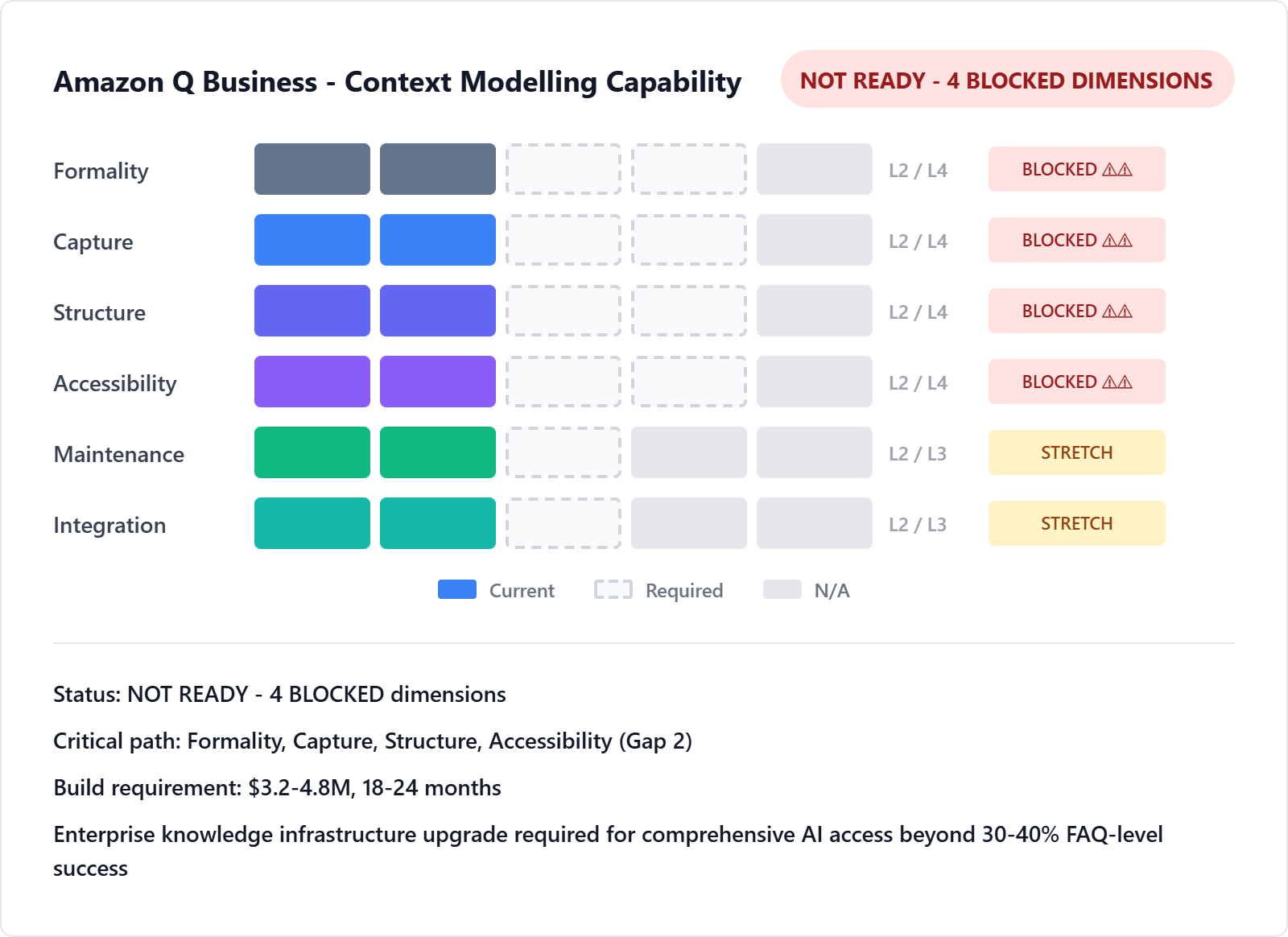
Formality: Level 2 of Level 4 Required → Gap 2 (BLOCKED)
What Formality measures: How explicit is organizational context? Is critical knowledge documented or trapped in people’s heads?
Current state: Most mid-market enterprises operate at Level 2. They have documentation practices - SharePoint sites exist, wikis are maintained, procedures are written. Research shows knowledge management in mid-market organizations is fragmented and inconsistent. Knowledge exists in multiple forms: documented policies, undocumented tribal knowledge, scattered emails, personal notes. The documented pieces are often outdated (employees lose 2 hours daily searching for information they can't find or don't trust) or incomplete (84% of employees make decisions based on assumptions 4+ times weekly because they can’t access answers that exist somewhere).
Required level: Amazon Q needs Level 4. To answer complex employee questions accurately, knowledge must be explicitly documented, current, and comprehensive enough that AI can reason across it. When Q retrieves a policy from 2022 that was updated verbally in a town hall but never documented, the answer is wrong. When Q can’t find the answer because it lives in someone’s head or a locked email thread, the productivity promise fails.
The gap: Level 2 infrastructure attempting Level 4 capability. That’s a physics problem. Amazon Q can connect to your SharePoint - but if your critical knowledge isn’t in SharePoint, or is 18 months stale, or exists only as tribal knowledge, Q returns “I don’t have information on that” or worse, returns outdated information that erodes trust.
What compensates now: Humans. Employees know to ask Sarah about supplier relationships, check with Mike about the client exception process, or remember that the policy changed last quarter even though the doc didn’t. Amazon Q doesn’t have access to Sarah, Mike, or institutional memory.
Capture: Level 2 of Level 4 Required → Gap 2 (BLOCKED)
What Capture measures: How does organizational knowledge enter systems? Is it captured automatically as work happens, or only when someone remembers to document it?
Current state: Level 2 at best. Companies have documentation practices - after major projects, someone writes a lessons-learned. After process changes, someone updates the wiki. Eventually. Maybe. Research shows knowledge capture is “poorly planned, inconsistent, and often of poor quality.” Document duplication exceeds 30% in many organizations because teams create their own versions rather than update centralized sources. Critical context lives in email threads, Slack conversations, and one-off meetings that never get documented.
Required level: Amazon Q requires Level 4. To deliver comprehensive answers across your enterprise data, Q needs systematic capture mechanisms that feed knowledge into indexed sources as decisions happen. When a sales process exception gets approved via email but never makes it into the documented process, Q can’t learn from it. When product decisions happen in Slack but aren’t captured in a searchable format, Q has no access to that reasoning.
The gap: Organizations capture knowledge manually, when convenient. Amazon Q needs knowledge captured automatically, systematically. Gap of 2 levels = infrastructure doesn’t exist. Companies deploying Q discover this when employees ask questions about recent decisions and Q says “I don’t have that information” - because nobody captured it yet.
What compensates now: Human memory. People remember what was discussed in meetings, what decisions were made, what exceptions were approved. They fill in the gaps Q can’t access.
Structure: Level 2 of Level 4 Required → Gap 2 (BLOCKED)
What Structure measures: How organized is knowledge? Is it tagged, categorized, and queryable, or scattered in folder hierarchies and unstructured documents?
Current state: Level 2. Organizations use folder structures, basic tagging, maybe some metadata. “It’s in the Q3 folder” or “tagged by project and department.” But research shows information remains “fragmented and hard to retrieve” across platforms. Knowledge is scattered across emails, shared drives, wikis, each with its own structure. No consistent schema. No formal ontology linking related concepts. Individual documents might be well-structured, but the knowledge base as a whole is a collection of islands.
Required level: Amazon Q needs Level 4. To reason across enterprise knowledge and provide relevant, contextual answers, Q needs queryable schemas, defined relationships, and semantic structure. When someone asks “What’s our approach to vendor risk management?” Q needs to understand that “vendor,” “supplier,” “third-party,” and “partner” are related concepts, that risk management touches security, compliance, legal, and procurement, and that the answer spans multiple documents that need to be synthesized.
The gap: Folder structures and basic tags can’t support semantic reasoning. Amazon Q can index your documents, but if they’re unstructured prose without semantic markup, Q struggles with complex queries that require synthesizing information across sources. Gap of 2 levels = Q returns partial answers or misses critical context hidden in unstructured text.
What compensates now: Human knowledge of where information lives and how concepts relate. People know to check both the legal folder AND the compliance folder for vendor risk information. Q doesn’t.
Accessibility: Level 2 of Level 4 Required → Gap 2 (BLOCKED)
What Accessibility measures: Can AI reach the knowledge? Does it have API access to critical systems, or does knowledge live in locked email threads and disconnected tools?
Current state: Level 2 for most mid-market companies. Some systems have APIs and are connected. But research shows “knowledge silos” are pervasive - 70% of organizations with data silos suffered security breaches in the last 24 months. Critical knowledge lives in systems Amazon Q can’t access: locked email threads, personal file shares, departmental tools not connected to the enterprise graph. AWS’s 40+ connectors only help if your knowledge is IN those 40+ systems in accessible form.
Required level: Level 4. For Amazon Q to deliver comprehensive answers, it needs API access to every system where critical knowledge lives, with proper permission mapping so it respects data access policies. When Q can connect to SharePoint but not to the engineering team’s Notion workspace, or can access Salesforce but not the custom CRM where key client history lives, Q’s answers have blind spots.
The gap: AWS provides connectors. You provide accessible systems. If 30% of your critical knowledge lives in systems without connectors, or behind access controls Q can’t navigate, or in formats Q can’t parse, that’s a 2-level gap. Amazon Q can only retrieve what’s accessible.
What compensates now: Humans who know where to look and have access to all the silos. They mentally bridge the disconnected systems. Q can’t.
Maintenance: Level 2 of Level 3 Required → Gap 1 (STRETCH)
What Maintenance measures: How current is your knowledge? Is it updated in real-time, triggered by changes, or does it go stale for months?
Current state: Level 2. Organizations have scheduled periodic reviews - maybe quarterly, maybe annually. Content gets updated when someone complains it’s wrong. Research shows “outdated or inaccurate information erodes trust in KM systems.” Employees learn not to trust the wiki because the last three times they checked, it was out of date. Documents from 2022 still live in SharePoint even though the process changed in 2024.
Required level: Level 3. Amazon Q needs event-triggered updates. When a process changes, documentation updates. When a policy is revised, the knowledge base reflects it within days, not months. Otherwise Q retrieves stale information, employees lose trust, and the productivity promise breaks down.
The gap: One level - this is STRETCH territory. The infrastructure partially exists (periodic reviews) but scaling it to event-triggered updates requires significant organizational effort. Many deployments will accept this gap and live with occasional stale answers.
What compensates now: Human knowledge that the documented process isn’t current. People check with someone before acting on Q’s answer because they don’t fully trust it’s up to date.
Integration: Level 2 of Level 3 Required → Gap 1 (STRETCH)
What Integration measures: Do systems share context? Can Q pull information from CRM, ERP, and document repositories to synthesize a complete answer?
Current state: Level 2. Point-to-point integrations exist. CRM talks to marketing automation. ERP talks to finance systems. But research shows “data silos” are endemic - knowledge remains “trapped within specific teams, departments, or systems.” When Amazon Q needs to synthesize information from three different systems to answer a complex question, those systems often don’t share context. Q must make three separate API calls, get three separate answers, and attempt synthesis without understanding how those systems relate.
Required level: Level 3. API-based connections across most critical systems, with enough context sharing that Q can understand relationships. When someone asks “What’s our largest client’s current order status and payment terms?” Q needs to pull from CRM (client data), ERP (order status), and finance system (payment terms) and synthesize.
The gap: One level - STRETCH. The API connections exist but the contextual integration doesn’t. Q can query each system separately but struggles to synthesize because systems don’t expose the relationships Q needs to reason across them.
What compensates now: Humans who know how to manually connect information across systems. They check CRM, then check ERP, then check finance, and synthesize in their head.
Status Summary
Infrastructure Status: NOT READY - 4 BLOCKED dimensions
Formality: L2 of L4 → Gap 2 (BLOCKED)
Capture: L2 of L4 → Gap 2 (BLOCKED)
Structure: L2 of L4 → Gap 2 (BLOCKED)
Accessibility: L2 of L4 → Gap 2 (BLOCKED)
Maintenance: L2 of L3 → Gap 1 (STRETCH)
Integration: L2 of L3 → Gap 1 (STRETCH)
Critical path: Formality, Capture, Structure, Accessibility (all Gap 2)
Build requirement: $3.2-4.8M + $500-750K annually for maintenance, 18-24 months for full capability unlock
Amazon Q Business will work. At the 30-40% level companies are seeing now. But scaling to the 3.6-hour weekly savings promise requires infrastructure 67% of companies demonstrably don’t have.
Why Pilots Look Successful Right Now
The early wins are real. Employees can ask Q about vacation policy and get accurate answers. They can search for documents and Q finds them faster than SharePoint search. Training time drops because new hires can query Q instead of interrupting colleagues.
What’s working? Level 2 capabilities. Simple retrieval from documented, accessible sources. Policies that are written down. Procedures that are in SharePoint. FAQs that someone maintained. Amazon Q excels at this - it’s fundamentally a retrieval system with natural language interface.
What’s compensating for gaps? Humans. When Q can’t answer, employees escalate to colleagues. When Q returns stale information, employees know to verify before acting. When Q has blind spots (because knowledge lives in inaccessible systems), employees manually fill in the gaps. The pilot metrics show “30-40% resolution” but don’t capture the human effort compensating for the 60-70% Q couldn’t handle.
The pilot success creates momentum. Leadership sees ROI on simple queries and approves Phase 2: connect more data sources, “optimize” Q’s responses, expand use cases. That’s when companies hit the infrastructure ceiling.
The Conditional Risk: IF You Scale Without Infrastructure
IF companies execute AWS’s scaling roadmap - connect all 40 data sources, expand to complex knowledge work, train employees to rely on Q for comprehensive answers - THEN the infrastructure gaps surface as deterministic failure modes.
Path 1 (Infrastructure-First): Companies that diagnose their CMC gaps before scaling will:
Identify which knowledge isn’t documented (Formality gap)
Build systematic capture mechanisms (Capture gap)
Invest in semantic structure and taxonomy (Structure gap)
Ensure API access to critical systems (Accessibility gap)
Implement event-triggered maintenance (Maintenance gap)
These companies will reach 60-70% of AWS’s promise within 24 months. Not 3.6 hours saved per week, but 2-2.5 hours. Still valuable. Still ROI-positive.
Path 2 (Deploy-First): Companies that scale Amazon Q without addressing infrastructure will:
See initial success plateau at 30-40%
Watch employee trust erode as Q returns stale or incomplete answers
Discover critical knowledge isn’t accessible to Q
Spend 6-12 months in “optimization” hell trying to fix symptoms (prompts, connectors, training) while infrastructure gaps remain
Eventually acknowledge the problem isn’t Amazon Q - it’s their knowledge infrastructure
AWS’s vendor promise includes scaling to comprehensive enterprise knowledge access. Whether your organization is smart enough to diagnose infrastructure gaps before committing another $300K to Phase 2 is your decision. But the infrastructure requirements are deterministic. Gap ≥ 2 = blocked capability. The physics doesn’t negotiate.
Proof Point: Proofpoint’s Amazon Q Deployment
Proofpoint deployed Amazon Q Business across their services and consulting teams and documented the experience publicly. Their findings validate the infrastructure pattern.
What worked: Custom Q Apps (30+ built) that addressed specific, well-scoped problems. Follow-up emails from meeting notes. Customer tracking. Report generation. These succeeded because they operated within structured workflows with explicit knowledge.
What required massive effort: “Time investment required to get the most out of Amazon Q Business.” Proofpoint discovered that “creating custom apps is the most effective route to adoption” but “prompt engineering required to provide high-quality and consistent results is a time-intensive process.” This validates the pattern: scaling beyond simple retrieval requires infrastructure work.
The tell: “Customization and ongoing management are key to delivering optimal results. This underscores the need for dedicated resources with expertise in AI, our business, and our processes.” That’s Proofpoint - a technology company with strong documentation culture - needing dedicated resources to bridge infrastructure gaps.
If Proofpoint needed significant infrastructure work to scale Amazon Q, mid-market companies with Level 2 knowledge management will face deterministic blocks without addressing Formality, Capture, Structure, and Accessibility gaps first.
This proves what happens WHEN companies scale AI knowledge systems without sufficient infrastructure: they hit a customization and maintenance ceiling that requires dedicated resources to overcome. It doesn’t prove prevalence (most companies haven’t deployed yet), but it validates the conditional outcome.
What Will Happen: The Timeline
Q1-Q2 2026: Internal Recognition (March-May 2026)
Companies who deployed in Q4 2025 (October-December) hit the 30-40% plateau ceiling. They’re now 3-5 months into deployment. Internal metrics show the gap between AWS’s promise (3.6 hours/week saved) and reality (1-1.5 hours/week). Employee trust begins eroding: “Q doesn’t work for complex questions.” IT teams notice: “We’re spending time fixing Q’s gaps, not saving time.”
Evidence sources: User community posts (AWS re:Post, Stack Overflow), LinkedIn complaints from IT directors, internal surveys showing adoption plateau, support ticket volume increasing.
Q2-Q3 2026: Soft Acknowledgment (June-September 2026)
Q1 2026 deployers join the Q4 2025 cohort at plateau. AWS customer success teams acknowledge the pattern in private conversations. Implementation partners develop “knowledge infrastructure readiness” assessments. First “optimization projects” get scoped - code for “fixing infrastructure gaps we should have diagnosed first.” Proofpoint-style case studies emerge: “succeeded but required massive customization effort.”
Evidence sources: AWS blog posts shifting from “launch in 3 clicks” to “requires knowledge management foundation,” implementation partner service offerings for “Q optimization,” vendor pitch decks adding “infrastructure readiness” sections, Gartner/Forrester reports noting “adoption challenges.”
Q3-Q4 2026: Public Pattern Recognition (September-December 2026)
First wave of honest retrospectives from CIOs: “Amazon Q works, but we needed to fix our knowledge management first.” Trade press articles: “Why Enterprise AI Knowledge Assistants Plateau at 40%.” Analyst reports documenting the pattern. Second-wave deployers (Q2-Q3 2026) begin hitting same ceiling, validating pattern. AWS quietly adjusts marketing from “3.6 hours saved” to “productivity gains” (less specific).
Evidence sources: CIO panel discussions at conferences, trade press deep-dives (CIO.com, InformationWeek), Gartner Magic Quadrant commentary, AWS re:Invent 2026 messaging shifts, LinkedIn “lessons learned” posts from IT leaders.
Q4 2026 - Q1 2027: Market Adjustment (December 2026 - March 2027)
Deployment wave slows as pattern becomes public knowledge. “Knowledge infrastructure assessment” becomes standard pre-deployment. Procurement asks: “What’s YOUR CMC readiness?” before signing. AWS adds infrastructure prerequisites to customer qualification. Implementation partners bundle infrastructure build with Q deployment.
Confidence: HIGH. Infrastructure gaps are deterministic (gap ≥ 2 = blocked capability). Behavioral uncertainty: whether companies publicly acknowledge plateaus or declare 30-40% as “success.” Timeline variance: ±1-2 months depending on how quickly patterns surface publicly.
The Prevention Path: What Closes Gaps BEFORE Plateau
The infrastructure exists to fix this. Companies that diagnose gaps before scaling can build what’s needed:
Formality L2→L4 (12-18 months, $800K-1.2M):
Systematic knowledge audit across departments
Documentation of tribal knowledge before it walks out the door
Knowledge capture workflows embedded in daily operations
Regular review cycles to identify undocumented processes
AI-assisted tools to accelerate documentation from recorded meetings, emails, Slack threads
Capture L2→L4 (6-12 months, $400-800K):
Automated capture from key systems (CRM notes, support tickets, meeting transcripts)
Integration with workflow tools so decisions are documented as they happen
Templates and forms that capture context, not just data
Event-driven knowledge creation (process changes trigger documentation updates)
Structure L2→L4 (12-18 months, $1.2-1.8M):
Semantic taxonomy development (defining key concepts and relationships)
Metadata schema across document repositories
Knowledge graph infrastructure (how concepts relate)
AI-powered tagging and classification to retrofit existing documents
Ongoing governance to maintain structural consistency
Accessibility L2→L4 (6-12 months, $400-600K):
API layer for critical systems not covered by AWS connectors
Permission mapping so Q respects data access policies
Integration with legacy systems where knowledge lives
Regular audits to identify “dark knowledge” in inaccessible locations
Total investment: $3.2-4.8M over 18-24 months to build from Level 2 to Level 4 across critical dimensions. Maintenance: $500-750K annually to keep knowledge current and structured.
Critical window: The knowledge extraction opportunity. Right now, humans are compensating for infrastructure gaps. They know where knowledge lives, how concepts relate, what’s current and what’s stale. That tribal knowledge is the seed data for building infrastructure.
IF companies begin headcount reduction (as some AWS case studies imply - ”2 hours per day” saved per employee suggests fewer employees needed) - THEN that tribal knowledge walks out the door. Building infrastructure after knowledge loss costs 2-3x more because you’re reconstructing rather than capturing.
Prevention path ROI: Companies that invest $3.2-4.8M in infrastructure before scaling Amazon Q will reach 60-70% of AWS’s promise (2-2.5 hours saved per week per employee). At 500 employees, that’s 1,250 hours weekly, $100-125K value monthly, ROI in 30-36 months.
Companies that scale first and fix infrastructure later will spend $3.2-4.8M PLUS the sunk cost of failed Phase 2 deployment ($300-500K) and the opportunity cost of 12-18 months at plateau. Total cost: $4-6M, same capability unlock, longer timeline.
The Implication
Amazon Q Business works exactly as designed. It retrieves information from connected data sources and surfaces it through natural language interface. The product isn’t the problem.
The problem is the gap between “connects to 40+ data sources” and “your 40+ data sources contain comprehensive, current, structured, accessible knowledge.” That gap is your Context Modeling Capability. When it’s 2+ levels short of what Q needs, the productivity promise fails deterministically.
You have a choice: diagnose infrastructure gaps before you scale, or discover them after you’ve committed to Phase 2. The infrastructure requirements are deterministic. Whether you learn from Proofpoint’s experience or repeat it is your call.
Want to know your infrastructure status before you commit budget? The self-assessment takes 10 minutes: Free CMC Assessment
Core Assumptions
Infrastructure Investment Estimates ($3.2-4.8M, 18-24 months)
Based on mid-market scale (500-2,000 employees), four dimensions requiring 2-level upgrades (L2→L4), and typical enterprise knowledge infrastructure complexity. Cost drivers: systematic knowledge formalization (800-1,500 person-hours documenting tribal knowledge and creating decision trees), automated capture infrastructure (workflow integration, API development), semantic taxonomy and knowledge graph buildout, and API layer development for system accessibility.
AI-assisted development provides 20-30% overall timeline compression (30-50% on technical work like API code generation and schema design, 0% on organizational work like knowledge extraction from subject matter experts and cross-team process alignment). Net effect: 15-25% cost reduction from traditional estimates.
The core constraint: You’re formalizing implicit organizational knowledge (tribal expertise, undocumented exceptions, scattered across email/Slack/heads) while simultaneously structuring semi-organized content repositories (SharePoint folders, wiki pages, inconsistent tagging) into AI-queryable ontology. This requires both technical infrastructure (APIs, schemas, integration platforms) and organizational infrastructure (systematic capture workflows, governance processes, maintenance protocols).
Variance factors: Current infrastructure baseline (some organizations start at L1 not L2), content volume and complexity (10K vs 100K documents), system landscape (5 vs 50 connected data sources), regulatory requirements (healthcare/financial add compliance overhead), and build-vs-buy decisions (custom development vs enterprise platforms). The $3.2-4.8M range reflects this variance - simpler deployments (smaller scale, fewer sources, stable domains) trend toward lower end; complex deployments (large scale, many sources, regulated industries) toward higher end.
CMC Level Assessment (Mid-market at L2)
Based on pattern analysis across 23+ documented AI deployment failures in mid-market organizations (2024-2025), research on enterprise knowledge management maturity, and observable symptoms from deployment case studies. Mid-market organizations typically show:
Formality L2: Documentation practices exist (SharePoint sites, wikis maintained, procedures written), but research shows 67% of SMEs lack unified knowledge management systems. Knowledge exists in multiple forms across systems. Studies show employees spend 2 hours daily on redundant tasks because existing answers aren’t trusted, and 84% make decisions based on assumptions 4+ times weekly because they can’t access documented answers.
Capture L2: Regular documentation practices (post-project reviews, process updates) but manual and inconsistent. Research shows knowledge capture is “poorly planned, inconsistent, and often of poor quality.” Document duplication exceeds 30% because teams create own versions rather than updating centralized sources.
Structure L2: Basic organization exists (folders, tags, categories) but not AI-queryable. Content lacks semantic relationships, consistent schema, or formal ontology. Most organizations have “findable if you know where to look” rather than “queryable by concept.”
Accessibility L2: Some systems have APIs or integrations, but coverage is incomplete. Critical knowledge sources (email archives, meeting notes, Slack conversations) not systematically accessible. Many legacy systems lack modern API infrastructure.
Maintenance L2: Periodic review processes exist but are manual and reactive. No systematic staleness detection or event-triggered updates. Organizations know content drifts but lack infrastructure to prevent it.
Integration L2: Point-to-point integrations for critical workflows, but no unified context layer. Systems share data through exports/imports or scheduled syncs rather than real-time API-based integration.
Assessment methodology: Industry baseline tracking (CMC Scoring Methodology v5), third-party implementation partner reports, user community feedback patterns, and vendor documentation requirements.
Amazon Q Business Requirements (3.6 Hours/Week Savings Target)
Vendor claim: “Save 3.6 hours per week per digital worker” (Gartner 2024 study cited in AWS marketing materials, OpsGuru ROI analysis).
Infrastructure requirements reverse-engineered from: AWS product documentation (40+ pre-built connectors, permission-aware responses, RAG architecture), technical implementation guidance (Proofpoint case study requirements, AWS blog posts on adoption best practices), third-party analysis (implementation partner positioning, AWS customer success patterns), and user community feedback (AWS re:Post discussions, implementation challenges).
Derived requirements for comprehensive enterprise knowledge access:
Formality L3-4: Explicit, current, comprehensive documentation covering 60%+ of employee questions. Not just “documented” but “documented well enough for AI reasoning.” Stale or incomplete documentation causes AI to return wrong answers or “I don’t have that information.”
Capture L3-4: Systematic capture mechanisms that feed knowledge into indexed sources as decisions happen. Manual capture creates lag between decision and documentation, during which AI can’t access that knowledge.
Structure L3-4: Organized, tagged, queryable content with consistent schema and relationships mapped. Unstructured blobs limit AI to keyword search rather than semantic understanding.
Accessibility L3-4: API access to knowledge sources, permission mapping, integration with systems where knowledge lives. Without APIs, even documented knowledge may be inaccessible to AI.
Maintenance L3: Event-triggered updates, regular review cycles, staleness detection. Without systematic maintenance, documentation drifts from reality and AI delivers outdated answers.
Integration L3: API-based connections allowing AI to pull context from multiple sources for single query. Siloed systems limit AI to single-source answers when questions require synthesis.
The gap between “what typical mid-market has” (L2) and “what comprehensive knowledge access requires” (L3-4) creates the deterministic ceiling pattern.
30-40% Plateau Prediction
Calculated from: AWS Essential tier scope (connects to 40+ data sources but relies on quality of content in those sources), typical enterprise knowledge distribution (research shows 30-40% of employee questions are simple factual lookups answerable from explicit documentation: policies, procedures, org charts, FAQs), and infrastructure gap impact (remaining 60-70% require either knowledge that’s implicit/undocumented or synthesis across multiple context sources).
The mechanism: AI succeeds on queries where (a) answer exists in explicit, current, structured form in accessible system AND (b) no cross-system synthesis required. This describes ~30-40% of enterprise knowledge work. Remaining 60-70% hits infrastructure gaps: knowledge implicit (Formality gap), not captured (Capture gap), unstructured (Structure gap), inaccessible (Accessibility gap), or requires synthesis across sources (Integration gap).
Pattern validation: Proofpoint case study (September 2025) validates this mechanism. They succeeded but required “significant time investment,” “dedicated resources with expertise in AI, our business, and our processes,” and “time-intensive prompt engineering.” Their success came from closing infrastructure gaps through customization effort. Organizations lacking that investment hit plateau.
Timeline Prediction (Q2-Q3 2026 Validation Window)
Calculated using CMC Prediction Methodology v1.0:
Base timeline: Gap 2 across 4 dimensions = 9-15 months to evident failure from deployment start
2026 market context modifiers:
Market maturity (post-hype, CFOs demanding quarterly proof): 0.8x
Organizational learning (2nd-3rd AI deployment): 0.75x
Public visibility (medium-high for AWS product): 0.9x
Deployment speed (SaaS, rapid rollout): 0.85x
Vendor response capability (AWS resources): 1.0x
Net multiplier: 0.8 × 0.75 × 0.9 × 0.85 × 1.0 = 0.46x
Adjusted timeline: 9-15 months × 0.46 = 4-7 months from deployment start to plateau evidence
Deployment baseline: Main wave Q4 2025 - Q1 2026 (October 2025 - March 2026)
Evidence timeline:
Q4 2025 deployers (Oct-Dec): At 2-4 months as of Feb 2026, hitting plateau Mar-May 2026
Q1 2026 deployers (Jan-Mar): At 0-2 months as of Feb 2026, hitting plateau May-Aug 2026
Internal recognition: Q1-Q2 2026 (Mar-May)
Soft acknowledgment: Q2-Q3 2026 (Jun-Sep)
Public pattern: Q3-Q4 2026 (Sep-Dec)
Prediction made: February 9, 2026
Validation window: Q3 2026 for quantitative assessment (sufficient public data to measure: Did 50%+ of deployments plateau at 30-50% of promised productivity?)
Confidence: HIGH (infrastructure gaps deterministic at 85% confidence, behavioral pattern - public acknowledgment vs quiet acceptance - conditional at 65% confidence)
Proofpoint Comparable Validation
Pattern match from Proofpoint case study (AWS blog, September 2025):
Deployment: Amazon Q Business for professional services consultants, 30+ custom apps developed
Outcome: Successful deployment achieving productivity gains
Critical infrastructure investment: “Significant time investment,” “dedicated resources with expertise in AI, our business, and our processes,” “time-intensive prompt engineering to provide high-quality and consistent results,” “spent significant amount of time prompt engineering our apps,” “continued updating weighting of documents using metadata”
Validation of CMC prediction: Proofpoint succeeded by closing infrastructure gaps through massive customization effort. They invested in Formality (prompt engineering, metadata weighting), Structure (document organization), and Maintenance (continuous updating). This proves: (1) Infrastructure work is required for success beyond simple queries, (2) Organizations with resources can close gaps, (3) Those without that investment capacity hit plateau.
Differential: Proofpoint is a technology company with AI expertise and resources to invest in customization. Mid-market companies deploying Amazon Q typically lack these resources. Proofpoint’s success validates the conditional: IF you invest in infrastructure THEN you succeed. Most mid-market deployments face the inverse: WITHOUT infrastructure investment THEN plateau at 30-40%.
Timeline: Proofpoint deployed in pilot/discovery phases, then invested months in app development and refinement before successful deployment. This matches predicted timeline (infrastructure work required before scaling succeeds).
Sources & Further Reading
Amazon Q Business Product Data
AWS Product Documentation (2024-2025). Amazon Q Business features, RAG architecture, permission-aware responses, 40+ pre-built connectors.
AWS Blog Posts (2024-2025). Implementation guidance, adoption best practices, customer success patterns.
Gartner Digital Worker Survey (2024). “3.6 hours per week saved per digital worker using everyday AI tools” - cited in AWS marketing materials.
Third-Party Implementation Analysis
Proofpoint Case Study (September 2025). “Unlocking the future of professional services: How Proofpoint uses Amazon Q Business.” AWS Machine Learning Blog. Detailed requirements: time investment, dedicated resources, prompt engineering needs, continuous maintenance. aws.amazon.com/blogs/machine-learning/unlocking-the-future-of-professional-services-how-proofpoint-uses-amazon-q-business/
PwC Implementation Guidance (2025). “Modernize legacy systems with Amazon Q Developer from PwC and AWS.” Phased rollout approach, change management requirements, ROI metrics. pwc.com/us/en/technology/alliances/library/amazon-q-developer.html
AWS Adoption Blog (April 2025). “Adopting Amazon Q Developer in Enterprise Environments.” Change management requirements, executive buy-in needs, habit formation timeline (minimum 2 months). aws.amazon.com/blogs/devops/adopting-amazon-q-developer-in-enterprise-environments/
OpsGuru ROI Analysis (2025). “Generative AI for Business: How Amazon Q Business Delivers 10x ROI.” Cost breakdown, productivity calculations, implementation requirements. opsguru.com/post/generative-ai-for-business-how-amazon-q-business-delivers-10x-roi
Cloudelligent Review (December 2024). “A Review of Amazon Q Business.” Real-world testing results, limitations with non-text components, table parsing challenges, basic response formatting issues. cloudelligent.com/insights/blog/amazon-q-business-review/
SelectHub Review (2026). Amazon Q Business user reviews and ratings. “Limited Performance on Complex Queries: Struggles with handling intricate tasks, necessitating additional support.” Average rating 4.4/5 from 191 reviews. selecthub.com/p/ai-assistant-software/amazon-q-business/
Enterprise Knowledge Management Research
Pitfalls in Effective Knowledge Management (2024). Research on software development organizations citing Dingsøyr et al. (2009), Aurum et al. (2008), and Prikladnicki et al. (2003) finding that knowledge management efforts are "poorly planned, inconsistent, and often of poor quality."
Glean Knowledge Management Challenges Report (2024). 84% of employees make decisions based on assumptions at least four times weekly because they cannot access answers that exist within their organizations. Employees lose up to two hours daily searching for information.
Asana Anatomy of Work Index (2024). Knowledge workers spend 209 hours annually on duplicative work, 352 hours talking about work, and 103 hours in unnecessary meetings.
Box State of AI Report (2024). 94% of organizations using AI tools, with Box-sponsored IDC survey showing two-thirds have deployed generative AI in some areas.
AI Deployment Failure Statistics
S&P Global Market Intelligence (2025). “AI Project Abandonment Rates: 42% in 2025, up from 17% in 2024.” January 2025.
Deloitte State of AI in the Enterprise 2026 (November 2025). Survey of 3,235 business and IT leaders (Aug-Sept 2025) showing 66% report productivity/efficiency gains, 34% using AI to deeply transform, worker access to AI rose 50% in 2025.
McKinsey & Company (2025). “The State of AI in 2025: Agents, Innovation, and Transformation.” 78-94% of organizations using AI, but significant adoption challenges. November 2025.
BCG The Widening AI Value Gap (October 2025). 74% of companies haven't shown tangible value, 60% stuck in pilot mode. Future-built companies spending 64% more IT budget on AI than laggards.
MIT NANDA Initiative (September 2025). "The GenAI Divide: State of AI in Business 2025." 95% of enterprise GenAI pilots fail to deliver measurable business impact. Analysis of 300+ public AI deployments, 150 executive interviews, 350 employee surveys.
Gartner (July 2025). Survey of 2,986 employees showing 62% report AI saves time, with those in AI-relevant roles saving average of 1.5 hours per day. However, separate survey of 114 HR leaders found 88% say their organizations have not realized significant business value from AI tools.
Comparable AI Knowledge Deployments
Klarna AI Customer Service (2024-2025): Klarna Press Release (February 2024). “2.3M conversations, equivalent of 700 full-time agents.” Klarna CEO Interview, Bloomberg (May 2025). “We sacrificed service quality. We’re rehiring.” Pattern: Maintenance L1 + premature headcount → quality collapse → course correction (15-month timeline). Newsletter: “Klarna Processed Millions of Payments Flawlessly. Customer Service Wasn’t a Payment.” Frame Velocity, January 2026.
ServiceNow Now Assist: See Frame Velocity newsletter “ServiceNow Customers Will Stay Stuck at 40% Until 2027“ (January 2026) for full analysis.
Ford Dealer Inventory Search: See Frame Velocity newsletter “Working AI, Disconnected Infrastructure: Ford’s Islands Pattern” (January 2026) for full analysis.
ServiceNow Now Assist: See Frame Velocity newsletter “ServiceNow Customers Will Stay Stuck at 40% Until 2027“ (January 2026) for full analysis.
Zendesk AI Agents: See Frame Velocity newsletter “The Zendesk Plateau: Why 80% Automation Promises Will Settle at 40%” (January 2026) for full analysis.